
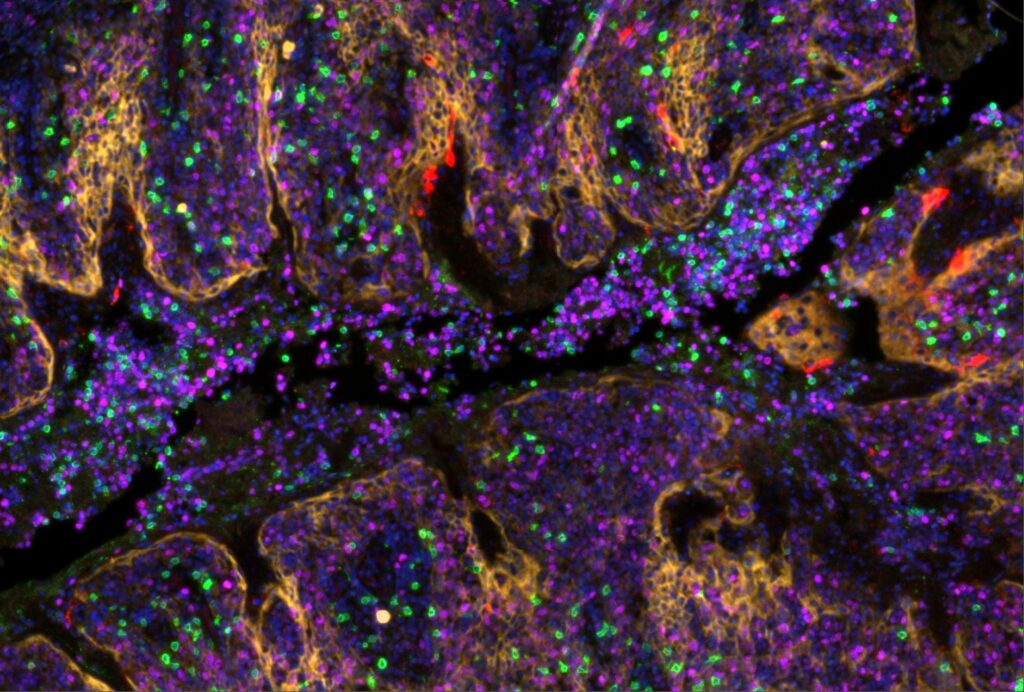
Immune responses are shaped not only by cellular composition, but by immune-cell state, tissue location, and spatial relationships. Multiplex immunofluorescence on FFPE tissue connects phenotype with tissue architecture while conserving precious samples.
Why multiplexing matters in immunology
Immune biology is rarely defined by a single marker. A T cell may be cytotoxic, regulatory, activated, tissue-resident, or functionally suppressed depending on the markers it co-expresses and the tissue environment in which it is found. A macrophage may contribute to inflammation, antigen presentation, tissue remodeling, or immune regulation, but no single marker fully captures its role. Low-abundance signals, such as checkpoint proteins, transcription factors, cytokines, or inflammatory mediators, can also be biologically important when they appear in specific cells or tissue regions.
Multiplexing makes these relationships visible in one FFPE section. Instead of asking only whether a marker is present, researchers can ask which cells co-express key markers, where those cells are located, and how they relate to surrounding tissue structures. This is particularly valuable in small biopsies, heterogeneous lesions, and archived FFPE samples where tissue material is limited.
Preserving tissue context
Flow cytometry and single-cell sequencing can profile immune populations in great detail, but tissue dissociation removes information about location, proximity, and organization. Conventional immunohistochemistry preserves morphology, but comparing several markers often requires serial sections. In heterogeneous samples, adjacent sections are not identical, and important cellular relationships may be missed.
Multiplex immunofluorescence helps close this gap by measuring several immune markers in the same tissue architecture. This allows immune phenotypes to be interpreted in relation to inflammatory interfaces, epithelial barriers, tumor regions, stromal compartments, damaged tissue, vessels, or lymphoid aggregates.
For example, CD3 identifies T cells broadly, but additional markers such as CD8, FOXP3, PD-1, Granzyme B, or other validated readouts can help distinguish cytotoxic, regulatory, activated, exhaustion-associated, or effector phenotypes. PD-1 should be interpreted carefully: it can reflect activation and, in sustained antigen exposure settings, exhaustion-associated biology. Similarly, markers such as CD68, CD163, and HLA-DR can help resolve myeloid diversity, but they are most informative as part of a panel rather than as fixed one-marker definitions.
What a practical FFPE workflow needs
FFPE tissue remains central to immunology and translational research because it preserves morphology, is widely available, and enables retrospective studies on archived material. It also introduces technical constraints. Fixation can reduce epitope accessibility, antigen retrieval can vary between targets, autofluorescence can increase background, and biopsy material may be scarce.
A practical multiplex workflow should therefore combine biological depth with assay robustness. It should conserve tissue, reduce repeated staining, preserve morphology, and provide sufficient signal for challenging targets. This is especially important in immunology, where relevant proteins may be weak, localized, or restricted to small immune-cell subsets.
For many focused immune-profiling questions, a compact panel of carefully selected markers can provide enough information to define cell identity, functional state, and tissue context without the complexity of very high-plex cyclic workflows.
Designing an immune panel
Strong panel design starts with the biological question. Every marker should clarify cell identity, function, compartment, or spatial relationship.
A practical panel often includes a lineage marker to identify the immune population of interest, a functional marker to report activation, suppression, exhaustion-associated biology, or effector state, a tissue or compartment marker to anchor spatial interpretation, and a nuclear counterstain or additional immune marker to support segmentation and cell classification.
A T cell-focused panel might combine CD3, CD8, FOXP3, and PD-1 or Granzyme B, depending on whether the question centers on regulation, checkpoint biology, or effector function. A myeloid-focused panel might include CD68, CD163, HLA-DR, and a tissue compartment marker. In inflammation studies, lineage markers may be paired with validated cytokine or inflammatory mediator readouts, particularly when those signals are expected to be rare, localized, or heterogeneous.
Why signal amplification matters
Many immunology targets are difficult to detect in FFPE tissue. Checkpoint proteins, transcription factors, cytokines, inflammatory mediators, and activation-associated proteins may be weak or present only in small cell subsets. Autofluorescence and fixation-related loss of epitope accessibility can further reduce contrast.
Signal amplification can improve detectability when it increases specific signal without adding unacceptable background or compromising spatial resolution. In immune profiling, sensitivity can influence the biological conclusion. A small population of Granzyme B-positive cells, a weak checkpoint signal, or a localized inflammatory mediator may be central to the immune response. If the signal falls below the detection threshold, the biology may be underestimated or missed.
From marker detection to spatial immune profiling
Multiplex immunofluorescence supports immune-cell phenotyping because it measures multiple markers in the same cells and the same tissue architecture. Researchers can evaluate whether CD8-positive T cells are associated with activation or effector markers, whether FOXP3-positive cells occupy specific tissue niches, or whether myeloid populations differ between inflamed and non-inflamed compartments.
It also enables spatial questions that dissociated methods cannot answer directly. Are immune cells excluded from a lesion or infiltrating it? Are they concentrated near epithelial barriers, antigen-rich regions, vessels, or damaged structures? Are rare populations forming clusters that suggest organized immune activity?
For tissue-based immunology, multiplex immunofluorescence offers a practical path from single-marker staining to spatial immune profiling. It helps conserve samples, preserve morphology, identify phenotypes that single stains can oversimplify, and reveal spatial patterns that shape immune biology.